Sunday, February 21, 2016

Faith in Humanity

Check out this 'Faith in Humanity' post by Vlade of Memecenter!
Although Memecenter is known for shoveling out hilarious memes faster than a bullet train, there are several posts on there that is quite deep. The Faith in Humanity series of posts by the user Vlade, for example, will leave you in awe while you were expecting just another ruddy joke.


All credit for this post goes to Vlade. Check out his work at http://www.memecenter.com/vlade/posts !

Tuesday, February 9, 2016

Science shall lead the way

Science shall lead the way


“Science knows no country, because knowledge belongs to humanity, and is the torch which illuminates the world. Science is the highest personification of the nation because that nation will remain the first which carries the furthest the works of thought and intelligence.” Said Louis Pasteur, the famous French microbiologist. This is indeed true. We are fortunately living in a world where science, reason and rationality are fast replacing ancient and twisted religious ideals and illogical rituals that shackled a large section of the Indian society not more than a few decades ago. This beacon of light that has lead us from the darkness of doubt to glory of knowledge shall indeed be the driving force behind the future development of India.

Science encompasses nearly infinite amount of topics. From the golden rays of light during a beautiful sunset to a rocket accelerating to escape velocity to launch into outer space, science surrounds us and plays a vital role in every aspect of our lives. When James Watt, the boy who played with the kettle, invented the steam engine, little did he realize that he started a chain of events that would take us from the embers of the great Renaissance to the revolutionary Industrial age. As industrialism and subsequently, urbanization, spread across the globe, the people who lived until then as peasants who tilled the land started transforming into workers of newly established activities belonging to the secondary and tertiary sectors of the economy. Science has helped us to dispel hoaxes, rise above and beyond limitations, and has truly unlocked the true potential of the human race.

India has a similar story to tell, although it was the colonisation by European powers that lead to the scientific development of India. We have definitely come a long way from the introduction of the first printing press at Goa in 1556, as now high rise malls and shopping complexes, several internationally renowned companies with multi-billionaire CEO’s at their helm, sprawling software parks and high skilled education centers are becoming common in India’s urban centers. India’s space missions are a testimony to just how much we can achieve, and to how much we can compete with international superpowers.

While development in India has by no means been stagnant, the bitter truth is that it is far from the levels achieved by European and American countries. The previously mentioned religious and caste-based stereotypes and the shockingly huge amount of population who still believe in such things have played a major role in hindering the nation’s development. Conservatives are getting it wrong on almost all facets, and are irrationally supporting worn ideals that form an obstacle to development.

All this means that it is past time that India has awaken to face the obstacles that has manifested itself as underdevelopment, poverty and inequality, crippling India’s development rate.

First and foremost, we should discard all baseless practices and believes, which is by no means limited to caste and religious ideals and also include inefficient economic processes and unreasonable laws of division and inheritance, and embrace change and science. We should try out new technologies being evolved and made available in the ever-expanding market. Spread of education and computer literacy will go a long way in promoting change and development in rural areas. Computers and the internet, which are increasingly taking over every aspect of our lives, can play a major role in development of our nation. Provision of smartphones and making internet access available all across India deserves nearly as much attention as improving agriculture and proper redistribution of land. Integration of satellite services into primary activities and using scientific research to develop bleeding-edge tech that can greatly simplify various processes and vastly improve the efficiency of various methods needs to be on the forefront of scientific development.

If our nation fully utilizes its potential and uses science as the basis of development, science will surely turn out be the force, as Buzz Lightyear’s catchphrase goes in the Toy Story movies, that takes us “To infinity…..and beyond.”

Article written by Aswin G

Saturday, January 30, 2016

Cracking the Enigma

The Imitation Game was centered around a top secret British programme at Bletchely that aimed to decode encrypted German communication during the second world war. Towards the end, the cryptography team engaged by the Churchill government sought to break a German encryption device, the “Enigma”, which was believed to be one of the greatest in history.

To decode a particular German message that had been encrypted by Enigma, it had to be fed back into a similar Enigma device. Though the British were in possession of the same, they were rendered helpless by lack of knowledge as to the settings of the device. The ingenuity of the system lay in the fact that the Germans meticulously switched the settings every midnight, leaving less than 24 hours for the cryptographers to decode the day’s encrypted communication. Adding to their woes, the machine had around five rotors and ten plug board cables, giving rise to several trillion possible combinations.


Cracking the code was of paramount importance as details regarding secret convoys, U-boats in the Atlantic and surprise attacks by Germany on the Allied forces were communicated via the encrypted format afforded by Enigma.


The polish mathematician, Marian Rejewski, was the first person to achieve a major breakthrough on the Enigma, when he developed a method to crack the key of the machine once sufficient messages encrypted with the same key was collected during a time when the Engima used just 3 rotors. However, this method eventually failed when the Germans decided to change the procedure for choosing indicator settings. However, after this he went on to construct an electromechanical machine called bomba kryptologiczna (literally meaning cryptologic bomb), which attempted to brute force the key of the Enigma. The Germans later added 2 more rotors, exponentially increasing the number of possible keys and rendering brute force mostly useless.

The infamous cryptanalysis work at Bletchley Park started on 4th September, 1939, when Britain declared war on Germany. Most of the work here, after receiving a jump-start due to the decision of Poland to share their research, was based on the principle of common words with known positions allowing identification of the key. (This is in contrast to the portrayal of the same in the movie The Imitation Game, where this realisation is the breakthrough that allows Alan Turing & Co to finally crack the Enigma.)  A British version of the bombe was designed by Alan Turing and built by Harold Keen, and was called 'Victory'. Over the next few years, over 200 such machines were built and placed in allied military bases so as to decrypt German communication effectively.

A rebuilt Victory machine, now residing at the Bletchley museum.


Due to the efforts of the entire team consisting of thousands working at Bletchley Park and because of an important mathematical input by Gordon Welchman, the Victory eventually succeeded in breaking several crucial messages transmitted over the Enigma, which later became a decisive factor in the Allied triumph over Germany in World War II.


Thus, one of the greatest encryption devices known to mankind, was broken due to the use of predictable words and repetitive communication, and set the wheels rolling for what eventually became the cyber world today.

Article written by Nivedith George and Aswin G

Sunday, January 24, 2016

The Imitation Game move review


The Imitation Game Review


When people talk to each other, they never say what they mean.’ This is one of the many dialogues from the Andrew Hodges biography based movie Imitation Game that reflects the life of an introverted genius, of an unsung hero. A man who saved the lives of millions by cutting the war short but who himself suffered an unfair life and death.
The story unfolds in three parts, all reflecting how a man who could decipher the trickiest cryptographic conundrums in the world could not decipher the intricacies involved in living the ‘normal’ human life. The crux of the film involves the life of mathematician Alan Turing, played by the very versatile Benedict Cumberbach, who is employed by the British Intelligence to crack the Enigma, the infamous encryption device that allowed the Nazis to communicate across the continent unrestricted. The film, directed by Morten Tyldum, is however not entirely about how the world war was won by five persons hunched over their work tables in a small town northwest of London. It is also a touching story on how the various characteristics that set apart Alan Turing, the obsessive compulsive genius, from the rest of the pack resulted in him making one of the most important contributions to modern humankind, while also condemning him to suffer a cruel death as a depressed loner.
The stigma that we have against people whose sexual orientation are different from what we term ‘normal’ was much more so during the time in which the movie is set. Just being a homosexual was a crime, one punished by severe means. One of the most significant quarters from where the Imitation Game found acceptance was from the LGBT community who lauded the makers for their strong take on the subject.


While the first part of the movie shows the protagonist being bullied by children in his school, the second part snaps back to portray him at his marvelling best, breaking codes and helping his country win the war. The final leg of the movie shows the anguish of a man who is judged for being what he is made to be and consequently punished for the same.
Though the film stars a cast line of talent that includes Matthew Goode, Rory Kinnear, Allen Leach, Charles Dance and Kiera Knightley, it is Benedict Cumberbach who steals the show completely. He is smooth and solid in his portrayal of the vulnerable Turing. Not only does he mould himself into the skin of Turing, he is convincing without a blink of effort, or so it seems. From the stammering speech typical of Alan Turing to the emotional moment when he breaks down when Joan visits him post war, Cumberbatch brings the his character to life with amazing accuracy that leave moviegoers awestruck.
The true legacy of The Imitation Game is in the strong messages it gives to all viewers. It teaches us that the circumstances of one’s birth does not define our lives, but it is the choices we make and the actions we take that does so. It teaches us to never judge a person for what he is, but rather for who he is. And above all, quoting the movie, it tells us that “It is the ones no one imagines anything of that does the things no one can imagine.”

To conclude, Imitation Game is a true masterpiece and a movie that will stand out and endure as the golden standard in the biopic genre for a long time to come. It is one truly worth adding to any movie collection.

Review by Nivedith George and Aswin G

Thursday, December 24, 2015

Identify file types easily

     Identifying file types is usually not on the agenda of a typical computer user. But it sure is useful in multiple situations, especially in things like online forensic analysis challenges. Receiving a file with an unknown or suspicious extension from an e-mail or a torrent download is also a fairly common occurrence. In such cases, you will want to find out the actual file extension to check for potential malicious content or to get the right software to open it.

     Either way, a reliable and free file extension software is hard to come by on the vast internet. So here, I'm directing you to a really great, really accurate online tool (with a standalone offline version) that does just this.

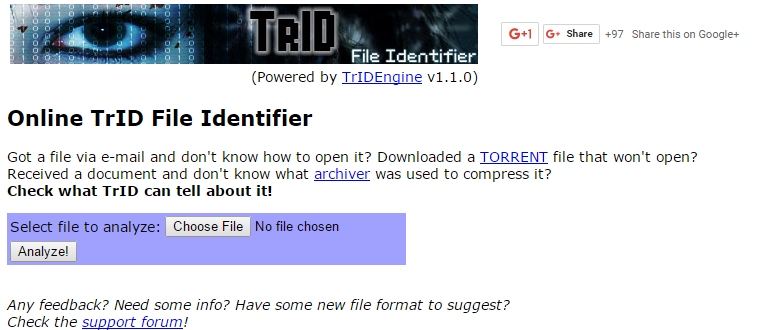
     The tool is called TrID file identifier, and can be found here : http://mark0.net/onlinetrid.aspx


     The process is as simple as uploading the file to be checked, and clicking the 'Analyze!' button.
If you have to analyse large files or is not comfortable with uploading personal files to the internet, the offline version can be downloaded and used instead. (Small heads-up: It is command line based, and lacks a GUI. Might be uncomfortable for some users.)

     This project has been active since 2003, and recognizes over 6315 file types, and is surprisingly well maintained and updated for it's age. It also support multiple platforms, and gives you just about anything you can ask for from such a tool.

Monday, December 14, 2015

Learn to Google the correct way!

     Everyone knows how to use the world's most popular search engine (And the most visited website, for that matter), right? No!

     Most of us, statistically about 90% of all Googlers, don't know how to use the search engine to it's fullest extent. We enter a general phrase we want to search for, and hope Google will turn up things we are looking for. There are, however, much better ways to use Google to ensure that you will get just what you want, every time you search.

     Google's advanced search options can add several modification parameters, but the best kind of modifications are done as you type in Google's search bar. Here are a few important ones:

" " →  Double quotes: Searches for an exact word or phrase. Doesn't bother for near-matches.

-<query>    →  Minus sign: Excludes a term from a search

~<query>   →  Tilde sign: Searches for related terms as well

<year>..<year> →: Searches for a time range

site: →:Searches for hits in a particular website.

     This infographic below sums up all such Google tricks and a few useful keyboard shortcuts for browsing. Totally worth checking out!

Friday, November 27, 2015

Youtube-Mp3 for fast, quick and efficient conversion

     Long ago, AGZuniverse  informed you about video2mp3, a great online tool for converting youtube videos to mp3 and downloading them on the fly. But many has since experienced problems with that site, probably due to overloaded servers unable to process to many requests. Here comes in another converter tool, which has been around for longer than video2mp3 : www.youtube-mp3.org/

     Why anyone would want to use such a tool requires no description, as nearly every internet user has those moments when he comes across a great song, speech, quote or background track in a video on Youtube, but decides not to grab due to the hassle of having to download the video first, trim it, and then convert it to mp3 using local/online converters. It's a waste of data, considering you have such services available.


     It's fast, with videos being converted and made available in a matter of seconds. The site being impaired due to server load is unlikely, as shown by it's longevity. The only downside is that the maximum quality is 128kbps, which may not be enough for some. But it's surely something to try out!

Friday, November 20, 2015

AdBlock may not always be your friend

     Installing a good quality Ad-Blocker is now one of the first things to do once you're done setting up your new browser. With stores of vast plugins supporting Google Chrome and Mozilla Firefox, the world's two most popular browers, this process is now as easy as it could ever get. 

     But what many don't realize is that Ad Block can block more than those annoying flashy ads that seem to clog up every other website. Sure, these softwares are up there with the most useful and most downloaded in their respective stores for a reason: They are damn useful, and they get their calls right 99% of the time.
     An advertisement or two may slip through every now and then. Hardly a problem. But the real issue is when ad-blockers block components of a website that stop it from functioning properly.

     The good news is, getting rid of this is as easy as turning off your ad-blocker. But first, you have to confirm if it is really the source of your issue.


     So you have ventured into a site that seems to work improperly. Go ahead, right click anywhere on the page and choose 'Inspect Element'. (Or just hit Ctrl+Shift+I). If you are running ad-blocker, chances are you will see errors (Specifically, the error: "ERR_BLOCKED_BY_CLIENT") on nearly every website that has ads blocked. But if you are on a trusted page that you know for a fact does not show ads, (Like a form submission page in most websites or a governmental website) and the errors are still present, turning off adblock will get the site running normally most of the time.


     If you find that adblock is blocking an essential plugin that websites normally use, such as jQuery and BootStrap, it can cause completely abnormal behavior, and turning it off should fix the issue once again.

     You cannot fully capitalize on the services of such technical gizmos unless you know when to and when not to use it. This awareness is imperative for happy and safe networking. Hope you enjoyed!

=)

Sunday, November 8, 2015

PicoCTF: Hacking challenge

     All the ones among us who show a keen interest in computers and programming, at some point or the other, is bound to have marveled at hackers navigating green falling matrices in Hollywood films, or wondered how hackers go through the most secure firewalls on the planet after reading news reports of hacker strikes or after finishing Dan Brown's novel 'The Digital Fortress'. 

     While using one's ability to steal sensitive data and turn lives of several innocent users into misery is a highly condemned practice, ethical hacking, or white-hat hacking, is an important skill that must be possessed by anyone looking to get into the field of system securities. Unfortunately, the majority of the present generation, while being well versed and quick to adapt to cutting-edge technological innovations, knows little about the underlying layers of security and their possible exploits.


     Whether you are just a tech junkie trying to learn more, or someone looking for new challenges in cryptography and programming, or someone genuinely interested in learning more about the field of security and encryption, Capture The Flag competitions or CTFs are just the right place to swing by. However, many such competitions are aimed at experts and sets the bar of standard very high, almost too high for newcomers to take up. This is where PicoCTF, a CTF challenge set up primarily for students, becomes just the perfect place for you. While the original PicoCTF 2014 competition is long done, all the challenges is still open for everyone around the world, to try out totally for free.


     While classic Vigenere Ciphers and simple substitution ones to modern-day XOR ciphers serve the main course in cryptography, brilliantly crafted codes in languages ranging from Java to assembly language provide plenty of reverse engineering fun. Add web exploitation and other interesting challenges to the mix, and what you have is an entertaining, non-boring, and educational series of challenges sure to thrill anyone willing to spent some time on it.

     Totally worth taking a look at!

Friday, October 30, 2015

Online Java IDE

     If you are a programmer, or even if you just code as a hobby, you will know how important having a well equipped IDE is for the creation and debugging of code.

     While web development can be handled easily using the built-in tools that come with popular browsers such as Google Chrome or Mozilla Firefox, certain other languages such as C++ or Java requires an IDE hundreds of megabytes in size. While it is strongly recommended that you go for a full IDE (Especially considering how most of them are free) if you are working on something serious, having to download and install a large file just for the execution of a few lines of code you picked up on the way can be a tedious process.

    In such cases, online IDE's are the way to go. These are websites that allow you to write, compile, debug, and execute code while using minimal data as the IDE is located in the website's server.

     I made a post about an online C++ shell a while ago, and now it's time to look at a Java IDE.

http://www.compilejava.net/ does the job beautifully well, no questions asked. 


It claims to be a Java compiler created in PHP, and allows you to key in code or paste source and see the compiler as well as the program output as the program runs. You can even enter command line arguments if necessary, and the whole thing comes with a number of delightful markup formats.

     Oh, the compiler is fully online, completely free to use, and no annoying registrations are required. Truly a great service!